

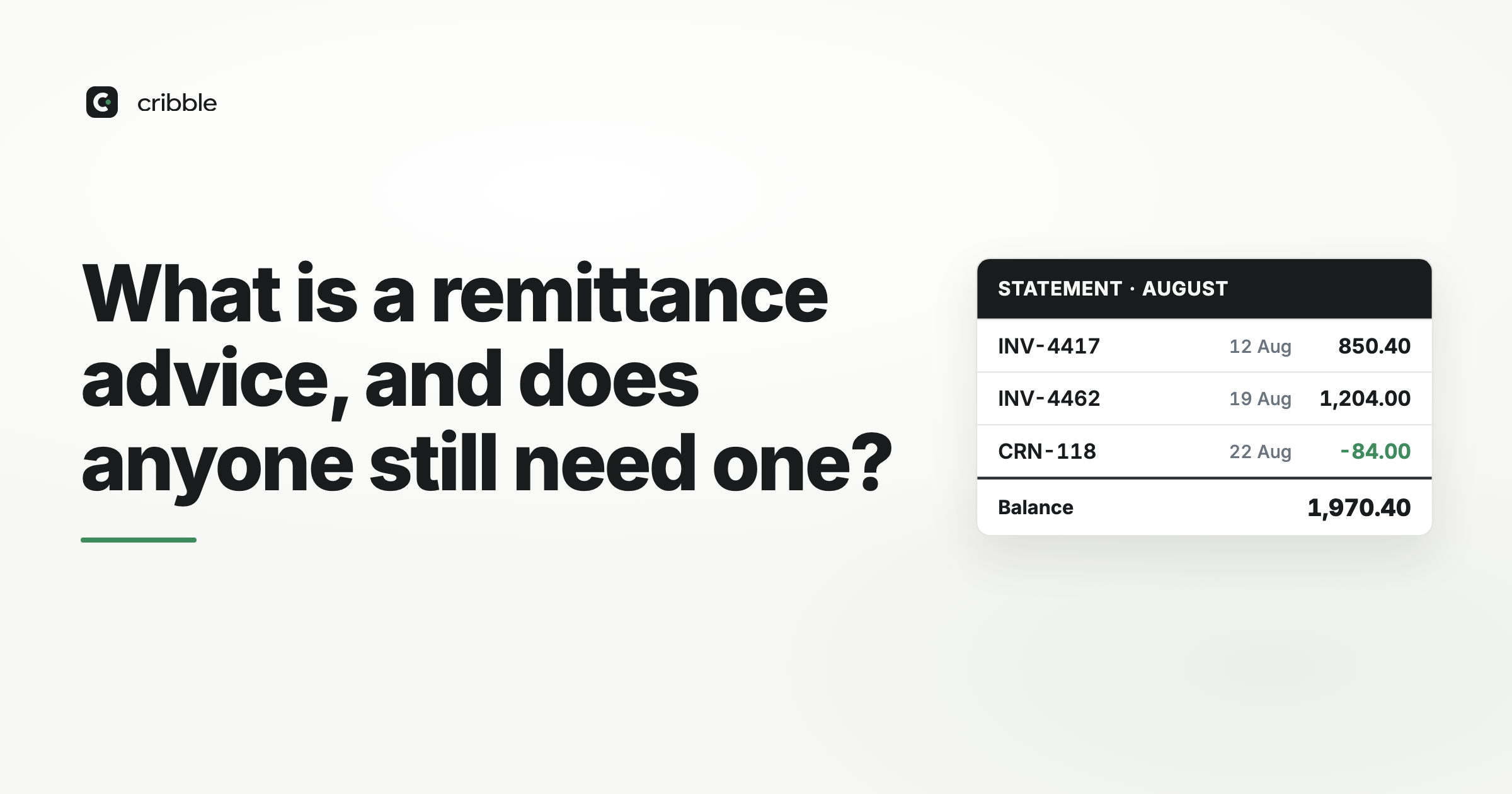
A remittance advice is a note from a payer to a supplier saying what a payment covers. It lists the invoices being settled, any credit notes applied, and the total sent.
It is not a legal requirement, it carries no accounting weight, and a great many businesses have quietly stopped sending them. Which is a small mistake, for reasons that have nothing to do with courtesy.
What it contains
- Your business name, so they can identify the payer
- The payment date, amount and method
- Each invoice number being paid, with its amount
- Any credit notes applied, with their references
- The total, reconciling to what actually hit their bank
The essential part is the middle: which documents this money settles. Everything else is context.
Why it exists
Bank transfers carry almost no information. A supplier sees a credit for £4,182.60 from a name that may or may not match how you appear in their ledger, with a reference field of eighteen characters that your bank may have truncated.
If that payment settles seven invoices, two of them partly, with a credit note applied, the supplier has to work out the allocation themselves. Their options are to guess, or to contact you.
They usually guess. That is the problem.
The reason it is worth your time, selfishly
A supplier who allocates your payment incorrectly produces a ledger that disagrees with yours. That disagreement surfaces later as:
- A statement showing invoices outstanding that you have paid
- A credit control call about a document already settled
- A reconciliation difference someone on your side has to investigate
- In the worst case, an account on stop over a payment that arrived weeks ago
Every one of those costs you time, and every one is prevented by a document that your accounting software can generate automatically.
The framing that gets this prioritised: a remittance advice is not a favour to the supplier. It is the cheapest available way to stop them raising queries you have to answer.
When it matters most
Consolidated payments. One transfer covering many invoices is unallocatable without a breakdown. This is the main case.
Part payments. A payment that does not match any invoice total will be misallocated almost every time, and it makes your aged report disagree with theirs.
Where credits are applied. The supplier sees less money than the invoices total and has to work out why. Without a note they may treat it as a short payment and chase the difference.
Multiple entities. If you pay from a group account under a name that differs from the account name, the supplier may not know who paid.
New relationships. Before conventions are established, the first few payments are the ones most likely to be misapplied.
Disputed accounts. When something is already contested, a payment with no explanation invites the wrong interpretation.
When it genuinely doesn't matter
Single invoice, paid in full, correct reference in the payment, established supplier who allocates by reference. There is nothing to explain. Sending an advice is harmless but is not buying you anything.
Being honest about this is worth it — a business that sends remittances only where they prevent an allocation problem is doing something useful, rather than adding a step to every payment run out of habit.
Practicalities
Send it when the payment goes, not before. A remittance for a payment that hasn't left causes its own confusion.
Send it to accounts, not your usual contact. Your sales contact will not forward it to their purchase ledger.
Use their invoice numbers, not yours. Your internal reference means nothing on their system. This is the most common flaw in remittances that are sent — and it is what makes an incoming one worth reading back against your own ledger rather than filing.
Automate it. Every serious accounting package will produce remittance advices from a payment run. If yours is being typed by hand, that is the thing to fix rather than the sending.
Keep it plain. A PDF or a plain email both work. It is a working document and nobody files it fondly.
Receiving them
The reverse case is worth a line, since most businesses do both.
If a customer sends you a remittance advice, use it. Allocating from the advice rather than guessing is faster and more accurate, and it prevents exactly the query cycle described above — this time with you on the receiving end.
If a customer never sends one and their payments are hard to allocate, ask. Most will happily switch it on; it is usually a setting rather than an effort.
Cribble handles the purchase ledger side — reading supplier invoices, scoring the extracted fields, and posting approved bills to Xero. Remittances are produced by your accounting system at payment, which is downstream of where Cribble works, but the allocation is a lot easier when the invoices behind it were entered accurately in the first place.