

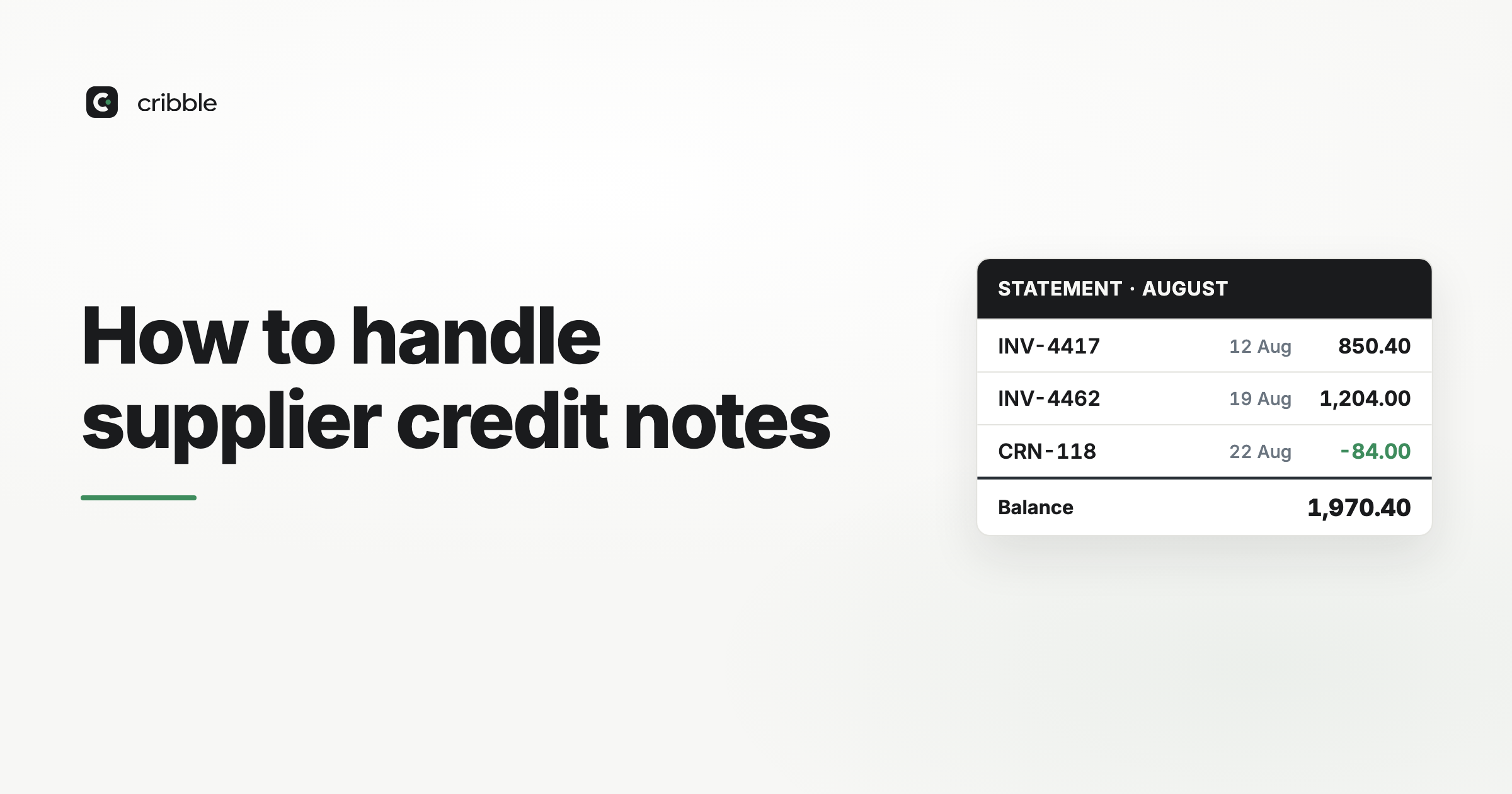
A credit note reduces something you owe. Posting one is straightforward. The trouble is almost never the posting — it's that the credit sits on the account unallocated while the invoice it was meant to reduce gets paid in full.
What a credit note actually is
A document from your supplier reversing part or all of a previous invoice. Goods returned, a short delivery, an overcharge, a pricing correction, a settlement discount applied after the fact.
Two things matter about it in a purchase ledger:
It is a document in its own right. It has its own number, date and VAT treatment. It is not an annotation on the invoice, and it does not replace the invoice.
It has to be applied to something. A credit note that exists but is not allocated is worse than one that was never issued, because now the ledger is right in total and wrong in detail — and you will pay the original invoice at its original amount.
The VAT is not optional
A credit note carries VAT, and it reverses the VAT on the original supply at the rate that originally applied.
That last part catches people out at rate changes. If the invoice was raised at one rate and the credit note is issued after a change, the credit follows the original supply, not today's rate. Your accounting software will usually default to the current rate, and it will be wrong.
The same logic applies to reverse charge supplies — if the original invoice was reverse charged, the credit note is too, and it needs to unwind both boxes rather than just the net.
Where credits actually go missing
They arrive separately from the invoice. Often weeks later, often from a different address, sometimes as a statement line rather than a document. Nothing links them except the reference, and the reference is frequently wrong.
They arrive as an email body rather than an attachment. "We've credited you £84 for the short delivery" in plain text is not a document anyone files.
They get posted and never allocated. The ledger shows the supplier balance net, which looks correct, so nothing flags. Then a payment run pays the invoices outstanding and the credit stays on the account.
They get applied to the wrong invoice. Common where a supplier issues several similar invoices a month. The balance is right and the detail is wrong, which only surfaces when someone queries a specific document.
They arrive after payment. Now you are owed money rather than reducing what you owe, and it needs actively recovering rather than passively netting off.
A process that holds
Post the credit as a document, not as an adjustment to the invoice. Editing the original invoice destroys the audit trail and breaks the match to the supplier's own records. Their statement will show two documents. So should yours.
Allocate at the point of posting. The moment the credit is entered is the moment someone knows what it relates to. A week later nobody does. If the related invoice isn't in the ledger yet, that's a reason to chase the invoice, not a reason to defer allocation.
Reconcile the supplier statement monthly for accounts with credits. This is the control that catches unallocated credits, and it is the only one that reliably does.
Run an unallocated credits report before every payment run. If your software can produce one, this takes a minute and is the single highest-value check in the process.
Treat a credit received after payment as a receivable. It needs chasing. Suppliers do not generally volunteer refunds, and a credit balance on a dormant supplier account is money you have lent them indefinitely — the same shape as an unresolved dispute.
The recurring case worth automating
Some credits are structural rather than exceptional — volume rebates, settlement discounts, consignment returns. These arrive on a predictable cycle from a small number of suppliers.
Worth handling as a standing arrangement rather than a monthly surprise: agree the reference format with the supplier, agree which invoices credits apply against, and check the arrangement is being followed rather than checking each document.
When the supplier won't issue one
Occasionally a supplier agrees a reduction verbally and never sends the document. Do not short-pay against a promise.
Short-paying an invoice without a credit note leaves a permanent unexplained difference on both ledgers, and it is your reconciliation that has to carry it. Ask for the credit note, pay in full if it hasn't arrived by the due date, and let the credit apply next time. It is slower and it is much cheaper than the alternative.
What good looks like
- Every credit is a posted document with its own reference
- Every posted credit is allocated to a specific invoice, or deliberately held with a reason
- No credit older than one cycle sits unallocated
- Supplier statements are reconciled where credit activity exists
- Nobody short-pays against a promised credit
Cribble treats a credit note as its own document rather than reading it as an invoice with a negative total, and keeps related documents linked so the credit, the invoice and the delivery note can be found together. Note that this is reference linking rather than purchase order variance matching — Cribble does not check quantities and prices back to a PO.